Interdisciplinary Journal
Volume & Issue: Volume 1, Issue 2, December 2023, Pages 59-104 
Number of Articles: 6
Elastic Constants and Elastic Moduli of Silicon Carbide Nanosheet

Elastic Constants and Elastic Moduli of Silicon Carbide Nanosheet

Pages 59-64

https://doi.org/10.22034/cas.2022.144399

Samira Salimi, Hojat Allah Badehian, Ziad Badehian

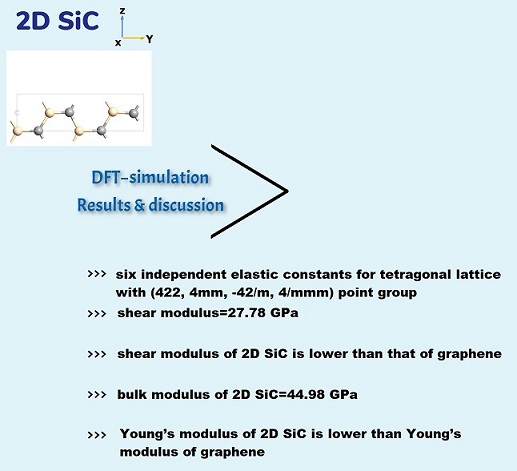
Abstract 2-Dmensional silicon carbide (2D SiC) provides several advantages compared to the bulk silicon carbide, due to its two-dimensional structure. Elastic constants and elastic moduli of 2D carbide nanotubes were calculated employing density functional theory (DFT). There are six independent elastic constants for tetragonal lattice with (422, 4mm, -42/m, 4/mmm) point group. The calculated , , , , ,  of 2D SiC are reported in this work. The results suggest that the shear modulus of 2D SiC is 27.78 GPa, which is lower than that of the of single layered graphene sheet (=0.22 TPa). The bulk modulus of 2D SiC is 44.98 GPa as well. Moreover, Young’s modulus of 2D SiC is lower than Young’s modulus of single layered graphene sheet. Compared to Young’s modulus of the amorphous phase of the SiC (=313.6 GPa), Young’s modulus of 2D SiC (=156.19 GPa) is smaller. The main reason is that the stiffness of the 2D SiC in the x direction is smaller than the stiffness of the bulk SiC.

Effect of Salinity and pH Changes on the Toxicity of Abamectin in Artemia franciscana using Response Surface Methodology

Effect of Salinity and pH Changes on the Toxicity of Abamectin in Artemia franciscana using Response Surface Methodology

Pages 65-78

https://doi.org/10.22034/cas.2022.144986

Sahel Pakzad Toochaei

Abstract The excessive increase in pesticides consumption has made concerns about aquatic ecosystems. Hence, the present study focused on the toxicity level of Abamectin as a widely used pesticide in Artemia franciscana. The lethality of Abamectin at different pHs and salinity was investigated to simulate the real natural status of A. franciscana. The salinity ranges of 10-255 and 10-130 g.l-1 with the pH range of 4-11 for water with a constant Lethal concentration 50 (LC50) (0.145 μg.l-1 from the toxicity test) were considered and evaluated using response surface methodology (RSM). A significant variation in Artemia mortality was observed at 0.145 μg.l-1 of Abamectin in the salinity ranges of 10-255 g.l-1, irrespective of the effect of pH. In the second phase of the experiment, a significant variation of mortality was observed in the level of LC50 in the salinity range of 10-130 g.l-1, which was associated with pH shifts (p<0.05). In addition, R2 adjusted, and predicted R2 of the model were equal to 0.985, 0.976, and 0.96, respectively. The reduction in the pH from 7.5 and the salinity from 30 g.l-1 intensified the lethal effects of Abamectin. The simultaneous increase in pH and salinity decreased the mortality level. Also, the increase in salinity raised the mortality rate. These findings may reflect the stressor effects induced by the change of physicochemical parameters on the tolerance of A. ftanciscana,s in confronting pollution exposure. Hence, it can be concluded that a severe decrement in salinity and pH can intensify the LC50, which exerts an adverse impact on osmoregulation and high energy demand.

The Effect of Stone-Wales Defect on the Geometrical Parameters and Electronic Properties of ACNTs (14, 14)

The Effect of Stone-Wales Defect on the Geometrical Parameters and Electronic Properties of ACNTs (14, 14)

Pages 79-84

https://doi.org/10.22034/cas.2022.323777.1009

Hojat Allah Badehian, Ziad Badehian, Azadeh Fatahpor

Abstract In this work, we intend to investigate the effect of Stone–Wales defect (SW defect) in armchair (14, 14) carbon nanotubes (ACNTs (14, 14)) and how it perturbs the energy states near the Fermi level. The SW defect may occur in graphene, carbon nanotubes (CNTs), and similar carbon frameworks, in which the four adjacent six-membered rings of a pyrene-like region turn into two five-membered rings and two seven-membered rings when the bond uniting two of the adjacent rings rotate. Our calculations indicate that ACNTs (14, 14) with SW defect have semiconducting behavior, although the armchair CNTs are expected to be metal. The band-gap of ACNTS (14, 14) with SW defect is 0.11 eV. In addition, the obtained results show that the density of states of ACNTs (14, 14) with SW defect reaches its zenith at 13 eV. The results show that the C–C bond lengths and diameter of ACNTs (14, 14) with SW defect are 1.40 Å and 18.74 Å, respectively.

DFT Study of Armchair Silicon Carbide Nanoribbons (w=3)

DFT Study of Armchair Silicon Carbide Nanoribbons (w=3)

Pages 85-90

https://doi.org/10.22034/cas.2022.323191.1008

Hojat Allah Badehian, Ziad Badehian, Rahim Sharifirad

Abstract The optical spectra of armchair silicon carbide nanoribbons (ASiCNRs) with edges passivated by hydrogen were calculated exploiting density functional theory (DFT). It was found that the dielectric function of the simulated nanoribbon has anisotropic behavior due to the asymmetric crystal lattice. Compared to isotropic behavior, anisotropic means different behavior in all directions. The first peak of the imaginary part of the dielectric function (2.57 eV) suggests that the first optical band-gap of ASiCNRs is 2.57 eV. Besides, the z component of the static refractive index of ASiCNRs is 1.34. Our results show that the first optical absorption’s peak for the z polarization happens at 2.57 eV, which is in agreement with the imaginary part of the dielectric function. The first and second peaks of the optical extinction are located at 2.57 eV and 3.42 eV as well.

Phonon Spectra of Monolayer Silicon Carbide

Phonon Spectra of Monolayer Silicon Carbide

Pages 91-96

https://doi.org/10.22034/cas.2022.322464.1007

Samira Salimi, Hojat Allah Badehian, Ziad Badehian

Abstract Silicon carbide monolayer is a promising material in the semiconductor industry. The silicon and carbon elements in the two-dimensional silicon carbide are arranged in a two-dimensional hexagonal lattice. The quantum of the crystal lattice vibrations, namely phonons, dominate mainly the physical characteristic of the crystals as a result of electron mobility. It is clear that the number of phonons is zero, from 85 meV to 117 meV. In addition, the silicon carbide monolayer sees its phonon density of states (PDOS) maximum at 140 meV, confirming that there are more allowed phonon energy levels at this point of energy. There are four peaks from 0 eV to 85 eV, indicating optical phonons and zone boundary (ZB) phonons. For the low-range energy, all electronic sub-bands correlate acoustic phonons, where the transverse acoustic phonons have lower energy than the longitudinal acoustic modes.

Effects of Long-Term Aloe vera (L.) Burm.f. Consumption on Histopathology and Blood Biochemistry Factors in Male Wistar Rats

Effects of Long-Term Aloe vera (L.) Burm.f. Consumption on Histopathology and Blood Biochemistry Factors in Male Wistar Rats

Pages 97-104

https://doi.org/10.22034/cas.2022.334686.1011

Mehdi Dehghani Kazemi

Abstract There is a general belief that herbal supplements and remedies have no harmful effects on the human body. However, liver problems caused by the overuse of medicinal plants in recent decades are a growing concern. This study aims at investigating the effects of long-term administration of Aloe vera extracts on liver histology and blood parameters of rats. Three groups of 10-week-old male Wistar rats were treated with Aloe vera leaf pulp, leaf gel, and a mixture of both for 56 consecutive days. Then the liver histology and blood biochemistry of control and experimental groups were analyzed. The hematological study indicated that long-term consumption of Aloe vera extracts affected the levels of AST and ALT enzymes meaningfully in experimental groups compared with the control group. Changes in other blood parameters, including fasting blood sugar, cholesterol, and Lactate Dehydrogenase (LDH) levels, were also detected in test groups in comparison with the control group. The histopathological findings demonstrated that hepatic steatosis was the most prominent effect of long-term consumption of Aloe vera fractions, which was consistent with the rise in the levels of ALP and ALT enzymes in the blood of test groups compared with the control group. The findings of this study are of importance, as they warn against the harmful effects of the overuse of the curative medicinal plant, Aloe vera, on mammals’ liver.