Interdisciplinary Journal
Volume & Issue: Volume 2, Issue 1 - Serial Number 3, June 2024, Pages 1-66 
Number of Articles: 6
Simulation of Ionic Conductivity of Lithium Borate Thin Films Using a Network of Electrical Resistors

Simulation of Ionic Conductivity of Lithium Borate Thin Films Using a Network of Electrical Resistors

Pages 1-8

https://doi.org/10.22034/cas.2022.337731.1013

Mohammad Reza Shoar Abouzari

Abstract Previous experiments show that the ionic conductivity of lithium borate thin films is strongly dependent on the thickness of the layers. A network of electrical resistors has been used as a model to describe the ionic conductivity of lithium borate films. This network consists of a large number of electrical resistors that have two different values. According to the percolation theory, the resistant network model describes the ion-conducting pathways inside the network of lithium borate glass. A MATLAB code has been written to calculate the equivalent network resistance, according to Kirchhoff's laws. The number of resistors in each direction of the network is proportional to the dimensions of the sample. The distribution of resistors in the network is random, but the relative probability of distribution for each of the two types of resistors is one of the parameters of this model. Experimental results show that the specific conductivity in thin films depends on the thickness of the layers, while it is constant in thicker layers. By examining various effective parameters in this model and according to the percolation theory, the non-trivial conductivity increase, observed in very thin layers, is simulated. The simulation performed by this model is satisfactory for both thin and thicker layers.

A Note on Finite Groups Whose Power Graph is a Commuting Graph

A Note on Finite Groups Whose Power Graph is a Commuting Graph

Pages 9-12

https://doi.org/10.22034/cas.2022.338526.1015

Alireza Doostabadi

Abstract Let G be a finite group. The power graph of the group G, denoted by P(G), is a graph such that its vertex set is the group G and two distinct elements x,y are adjacent if and only if x = yn or y = xn for some positive integer n. The purpose of this paper is to study finite groups such that their commuting graph is a power graph.

Laboratory-Based Diagnostic Tools for COVID-19: An Overview of Challenges and Limitations

Laboratory-Based Diagnostic Tools for COVID-19: An Overview of Challenges and Limitations

Pages 13-30

https://doi.org/10.22034/cas.2022.340428.1018

Surabhi Shukla, Suruchi Singh, Namrata Khanna, Tanushri Chatterji, Upasana Yadav, Reeta Maurya, Sadanand Pandey

Abstract The spread of severe acute respiratory syndrome coronavirus-2 (SARS Cov-2) as a pandemic has been a catastrophic clinical situation afflicting millions and affecting the socioeconomic scenario across the world. These unprecedented circumstances have evoked the need for an early and accurate diagnosis, followed by immediate and effective treatment of the disease. A reliable, rapid, and correct diagnosis is required to prevent transmission and for early patient management. False-negative results hasten the spread of the contagion, while false-positive results cause nonessential therapy and may result in unwarranted agony to the individual. Therefore, detection of the virus should be through accurate, rapid, and convenient diagnostic tests. Various immunological and nucleic acid amplification-testing kits are currently in use. Reverse transcription-polymerase chain reaction (RT-PCR) is a promising technique for COVID-19 diagnosis, but it is not accessible at the primary hospital level. For accurate detection of the coronavirus, sample collection plays a crucial role. Usually, a nasopharyngeal swab is collected as a sample. However, in some instances, to confirm detection, sputum and bronchoalveolar lavage (BAL) samples may be obtained from the lower part of the respiratory tract. The purpose of this review is to provide a brief overview of the specimen selection and laboratory techniques available for detecting SARS Cov-2 so that medical professionals can strategize the setting up of sophisticated and well-equipped diagnostic centers.

Preparation of pH-Responsive Vesicular Doxorubicin: Evidence from In-Vitro and In-Silico Evaluations

Preparation of pH-Responsive Vesicular Doxorubicin: Evidence from In-Vitro and In-Silico Evaluations

Pages 31-48

https://doi.org/10.22034/cas.2022.346726.1024

Saman Sargazi, Mahmood Barani, Farshid Zargari, Rabia Arshad, Rakesh K. Sharma

Abstract Colloidal nanocarriers have provided great opportunities in the field of drug delivery. In this study, to achieve the efficient delivery of anti-cancer agents at the site of action, doxorubicin (DOX) was encapsulated within pH-responsive ergosterol-modified niosomes. The niosome-based formulation displayed size of 125 nm, a surface charge of -22.7 mV, a DOX encapsulation efficiency (EE) of 70.8%, and pH-responsive release behavior. An in-silico approach was conducted to analyze the interactions of the loaded drug with the niosome bilayer and to evaluate the structural and dynamical properties of the loaded nanovehicle by constructing a niosome bilayer model containing Tween 60, Span 60, and ergosterol molecules. Computational analyses revealed that the  a-hydroxy ketone and daunosamine moieties of DOX are responsible for its arrangement towards the niosome bilayer. On the other hand, the cytotoxic activity of encapsulated DOX compared with its free form in an MCF7 breast cancer cell line was evaluated. Compared with free administered DOX, we found lower IC50 values for the MCF7 cells exposed to niosomal DOX (1.153 vs. 0.229 after 24 h, 0.796 vs. 0.148 µg/mL after 48 h, and 0.461 vs. 0.081 µg/mL after 72 h of incubation, respectively). Additionally, niosomal DOX-induced apparent morphological alterations in MCF7 cells. Hence, we showed that niosomes are promising nanocarriers that can be used to encapsulate and release well-established anti-cancer drugs in order to improve their release and, thus biological activity and therapeutic efficacy.

Diagnostic Value of Amsel Clinical Criteria Compared to Nugent Scoring System for the Diagnosis of Bacterial Vaginosis in Pregnant Women

Diagnostic Value of Amsel Clinical Criteria Compared to Nugent Scoring System for the Diagnosis of Bacterial Vaginosis in Pregnant Women

Pages 49-58

https://doi.org/10.22034/cas.2022.350010.1025

Roghayeh Sheervalilou, Fatemeh Haidari, Maryam Razavi

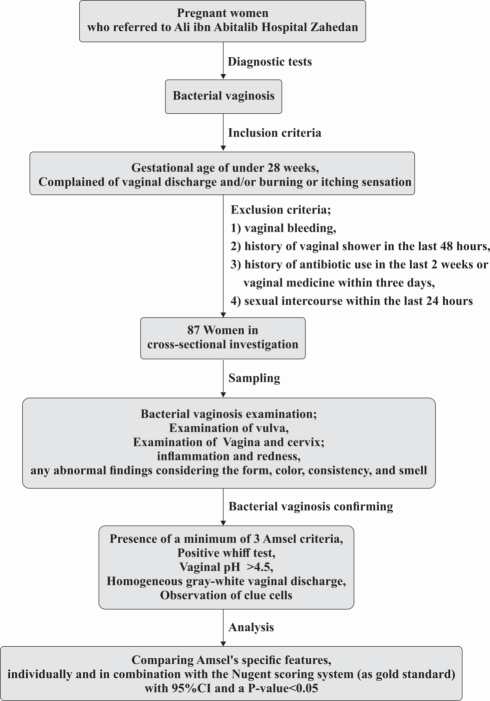
Abstract Most clinicians prefer to apply more readily accessible clinical techniques for the diagnosis of bacterial vaginosis, which at the same time are time-conserving and highly accurate. The current cross-sectional study sought to evaluate the bacterial vaginosis diagnostic tests on 87 pregnant women referred to our center due to vaginal discharge using Amsel criteria and the Nugent scoring system. Our results showed that the Amsel criteria had a significantly higher sensitivity/specificity than the Nugent scoring system regarding the number of clue cells in the vaginal wet mount test. The specificity of a combination of the wet mount of clue cells in the vagina with other Amsel criteria along with the Nugent scoring system was much higher than both the Amsel criteria and Nugent scoring system. We observed that due to the high efficacy and the great time-conserving and economically-friendly nature of the Amsel criteria, the method is usually opted for by clinicians.

Determination of Phenolic and Flavonoid Contents of Roots and Shoots of Euphorbia serpens Kunth Using Different Solvents

Determination of Phenolic and Flavonoid Contents of Roots and Shoots of Euphorbia serpens Kunth Using Different Solvents

Pages 59-66

https://doi.org/10.22034/cas.2022.354096.1026

Mehdi Dehghani, Hamid Beyzaei, Zahra Ebrahimnezhad

Abstract Euphorbia serpens Kunth (Euphorbiaceae) is an exotic annual plant species native to South America but is regarded as a pantropical weed. In this paper, the total phenolic and flavonoid contents of ethanolic, methanolic, dichloromethane, and petroleum ether extracts of shoots and roots of Euphorbia serpens were assessed in vitro. The plant materials were collected from Zabol, Sistan and Baluchestan in June 2022. The Folin-Ciocalteu and aluminum chloride colorimetric instructions were followed to evaluate the total phenolic and flavonoid contents of the extracts, respectively. The methanolic extract of aerial parts contained the highest amount of phenolic compounds (59.205 mg GAE/g), while the lowest content of phenols was found in the dichloromethane extract of roots (29.794 mg GAE/g). Also, the greatest amount of flavonoids was recorded for methanol extracts of aerial parts (34 mg RE/g), whereas the ethanol extract of roots contained the lowest amount of flavonoids (1.204 mg q/g). The aerial parts of Euphorbia serpens, in general, contain higher amounts of polyphenols as compared with the underground parts. The results also showed that phenolic and flavonoid contents vary significantly with the employed solvent. It can be concluded that the aerial parts of Euphorbia serpens are rich sources of polyphenolic compounds, signaling their potential for high antioxidant activity and nutritional and pharmaceutical importance.