Interdisciplinary Journal

Current Applied Sciences (Abbreviation: Curr. Appl. Sci.) is an open access, international, semiannual and peer-reviewed journal that established by the University of Zabol, Iran. The journal aims to provide a platform for academicians, researchers and scientists to share knowledge and ideas in the form of high-quality articles, original research or review covering in the following fields:

Mathematics

Physics

Chemistry

Biology

Material Science

Nanotechnology

Statistics

Biotechnology

Food Science

Computer Science

Information Technology 

All manuscripts submitted to Curr. Appl. Sci. are published Free of Charge. 

Enhancing the Detail Resolution of Foggy Images Using Fuzzy Histogram Equalization with Weighted Distribution

Enhancing the Detail Resolution of Foggy Images Using Fuzzy Histogram Equalization with Weighted Distribution

Pages 1-14

https://doi.org/10.22034/cas.2025.520327.1048

Najme Ghanbari

Abstract Enhancing image quality is an essential step in developing computer vision since it can significantly increase the efficacy of other algorithms, such as object recognition. Image quality improvement has been done in many different sectors to recover and analyze various aspects. This study combines a weighted fuzzy histogram equalization method with other image quality improvement algorithms to rebuild images affected by inhomogeneous blur. This process begins by generating a phase dissimilarity histogram of the brightness of neighboring pixels to enhance contrast. Gamma correction is then used to boost the dark areas, and maximum saturation is used to prevent the fading effect. The proposed method was evaluated using the PSNR and SSIM indices. These indices are calculated for the results of the proposed method and compared to the previous images. The effectiveness of the proposed algorithm in reconstructing images and the degree to which the results closely resemble the original images will be determined by this comparison. This article also included a qualitative review, the results of which were discussed. Although this method generally sharpens visual details, it might not significantly increase scores in this particular scenario.

Toxicity Challenges of Metal Nanoparticles in Zoonotic Disease Treatment: Strategies and Innovations

Toxicity Challenges of Metal Nanoparticles in Zoonotic Disease Treatment: Strategies and Innovations

Pages 15-24

https://doi.org/10.22034/cas.2025.534545.1052

Athena Maleki, Davood Dorranipour, Mohadese Sajedi-Moghaddam, Mostafa Peyvandi, Sérgio Amorim de Alencar

Abstract Metal nanoparticles (MNPs) have garnered significant attention for their potential application as a novel means of combating zoonotic diseases. MNPs are unique, not only due to their small size but also their high surface-to-volume ratio and their potent antimicrobial properties. Despite the challenges posed by parasitic zoonotic diseases that are transmitted from animals to people, their effective treatment remains a serious public health concern. Although MNPs have been shown to have some potential advantages, several challenges are associated with their use, including cytotoxicity, bioaccumulation, adverse immune reactions, and unanticipated, possibly harmful side effects that may adversely affect health. The purpose of this review article is to examine the challenges associated with the toxicity and side effects of MNPs in the treatment of parasitic zoonotic diseases, as well as potential strategies that can be adopted to minimize these impacts. Recent studies in this area have focused on optimizing nanoparticle design and surface modification, utilizing biocompatible coatings, reducing therapeutic doses, and developing targeted drug delivery systems, thereby maximizing efficiency and accelerating the delivery of drug. Several solutions have been proposed in this regard, including the surface engineering of nanoparticles with biocompatible coatings, nanoliposomes, and magnetic nanoparticles designed to deliver drugs specifically, as well as innovative technologies that can help control the release of drugs. Furthermore, it is possible to develop toxicity prediction models using artificial intelligence and bioinformatic analyses to help identify risks arising from the use of nanoparticles more accurately.

Prospects and Challenges of Nanotechnology in the Treatment of Pediatric Diseases

Prospects and Challenges of Nanotechnology in the Treatment of Pediatric Diseases

Pages 25-38

https://doi.org/10.22034/cas.2025.536702.1053

Kiarash Abdollahi, Noushin Moradi, Melina Barahouei Moghaddam, Samira Lashani, Mohammad Sajjad Najimi, Fatemeh Ghorbannejad Nashli, Yeganeh Yazdanshenas, Mahsa Mohammadian

Abstract As a new approach, nanotechnology has opened up new horizons in disease diagnosis and treatment. Nanotechnology, utilizing nanomaterials and targeted drug delivery systems, has addressed numerous challenges in treating pediatric diseases. Pediatric diseases present unique challenges in treatment management due to the specific physiological characteristics of this age group, including the need for accurate drug dosages, minimizing side effects, and enhancing treatment efficacy. Nanotechnology offers groundbreaking applications in the diagnosis and treatment of childhood diseases, providing targeted therapies with enhanced efficacy and reduced side effects. Key applications include nano-drug delivery systems for the precise treatment of pediatric cancers (e.g., leukemia and brain tumors), nanosensors for the early detection of metabolic and infectious diseases, and nanoparticle-based inhalable therapies for respiratory conditions such as asthma. Additionally, nanotechnology enables improved bioavailability and reduced drug dosages, critical for pediatric patients. However, challenges such as long-term safety, biocompatibility, and regulatory hurdles remain. Future directions include the development of multifunctional nanoplatforms for combination therapy and personalized medicine, alongside advances in scalable and cost-effective manufacturing. Addressing these challenges will be essential for translating nanomedicine into mainstream pediatric healthcare.

Investigation of the Mutual Interactions of the Sodium Ion and Some 15-Crown-5 Ethers through an Experimentally Based QSPR Model and Quantum Mechanical Features

Investigation of the Mutual Interactions of the Sodium Ion and Some 15-Crown-5 Ethers through an Experimentally Based QSPR Model and Quantum Mechanical Features

Pages 39-53

https://doi.org/10.22034/cas.2025.233426

Mahmood Sanchooli, Pouya Karimi, Fereshteh Shiri

Abstract The mutual interactions between the sodium ion (Na+) and hydrogen, carbon and oxygen atoms of the rings of a number of 15-crown-5 ether (15C5) derivatives were explored. Three different categories of descriptors including dipole moments, orbital energies and atomic charges were obtained from quantum mechanical calculations. A reliable correlation between stability constant (logK) of the 15C5 ethers and the mentioned electronic features was constructed. The model reveals considerable contributions of the C8 and C9 atoms in comparison to the other atoms in the rings. Moreover, quantum mechanical calculations confirmed the role of these two carbon atoms on the stability of the structures. Furthermore, a quantitative structure property relationship (QSPR) model was conducted on stability constant values of the mentioned complexes. Furthermore, it is found that a significant electron charge density has condensed between the hydrogen atoms of the rings and sodium ion. Also, ionic character of the interactions between the sodium ion and oxygen atoms of the ring was verified.

Surface Plasmon Excitation in a Spherical Nanocavity: The Hydrodynamical Drude Model

Surface Plasmon Excitation in a Spherical Nanocavity: The Hydrodynamical Drude Model

Pages 54-61

https://doi.org/10.22034/cas.2026.574826.1060

Moslem Mir

Abstract We theoretically study nonlocal effects in surface plasmon excitations in a spherical dielectric nanocavity embedded in a metallic host within the framework of the hydrodynamic Drude model. An analytical expression for the surface plasmon resonance frequencies is derived, enabling a transparent interpretation of size-dependent and material-dependent plasmonic behavior beyond the local approximation. Nonlocality is shown to modify the plasmonic response, leading to a blueshift of the resonance frequencies as the nanocavity radius decreases. We further demonstrate that the background dielectric constant associated with the metal ion core plays an essential role in the excitation process. For nanocavities with dielectric constants smaller than that of the metallic background, the surface plasmon resonances shift to higher frequencies, while a redshift occurs when the cavity dielectric constant exceeds the background value. In addition, increasing the nanocavity dielectric constant enhances the influence of nonlocal effects on surface plasmon excitations. These parameters offer valuable guidance for the design of subwavelength plasmonic structures.

On <em>N</em>(<em>k</em>)-quasi Einstein Manifolds Satisfying Some Conditions

On N(k)-quasi Einstein Manifolds Satisfying Some Conditions

Pages 62-67

https://doi.org/10.22034/cas.2026.569904.1058

Ali Akbar Hosseinzadeh

Abstract In this paper, we study -curvature tensor on -quasi Einstein manifolds. The tensor ​ is defined as a modification of the Riemannian curvature tensor involving the Ricci operator. Several of its basic properties are first derived with respect to the structure vector field , the associated 1-form , and the Riemannian metric . Using these relations, we investigate curvature conditions involving . In particular, we consider the condition and . All the results obtained are in the form of necessary and sufficient conditions.
2010 AMS Classification: 53C25

Dynamic Characterization of One-Dimensional Consolidation: A Rationalized Haar Wavelet Transform Approach for Variable Coefficient of Consolidation

Dynamic Characterization of One-Dimensional Consolidation: A Rationalized Haar Wavelet Transform Approach for Variable Coefficient of Consolidation

Pages 68-76

https://doi.org/10.22034/cas.2026.244805

Navid Shamlu Moghaddam, Amir Bazrafshan Moghaddam

Abstract The classical theory of one‑dimensional consolidation, originally developed by Terzaghi, is based on the simplifying assumption that the coefficient of consolidation (Cv) remains constant throughout the dissipation of excess pore water pressure. In practical geotechnical engineering applications, however, saturated cohesive soils frequently exhibit permeability and compressibility that vary with both time and depth, leading to a coefficient of consolidation that is inherently non‑uniform. To address this limitation, the present study introduces an analytical framework that incorporates the Rationalized Haar Wavelet Transform for solving the one‑dimensional consolidation equation with variable (Cv). Two functional forms are proposed to represent (Cv) as explicit functions of time and space, enabling a more realistic characterization of soil behavior during consolidation. The results demonstrate that accounting for variable (Cv) produces higher excess pore pressure predictions compared with the classical constant‑parameter solution, thereby increasing the estimated duration required to achieve full consolidation. This outcome indicates that traditional analyses may underestimate consolidation times in engineering design. Furthermore, the proposed methodology offers substantial flexibility by allowing a wide range of explicit (Cv) functions to be incorporated, making it adaptable to diverse soil conditions and site‑specific characterization. The study underscores the significance of incorporating variable soil properties in consolidation analysis and provides a robust computational approach for advanced geotechnical modeling.

Study of Gemcitabine Adsorption on the Surfaces of Different Types of Boron Nitride Nanotubes

Study of Gemcitabine Adsorption on the Surfaces of Different Types of Boron Nitride Nanotubes

Pages 77-95

https://doi.org/10.22034/cas.2026.245722

Mahdiye Poorsargol, Mansoureh Rakhshanipour, Zahra Setayesh‑Mehr

Abstract Departing from conventional density functional theory approaches, this study employs, for the first time, molecular dynamics simulations to investigate gemcitabine adsorption on the inner and outer surfaces of BNNTs with five chiralities: (7,7), (8,8), (9,9), (8,6), and (11,0). The primary innovation of this study lies in identifying a "diameter- and chirality-dependent interaction map," which expands upon existing knowledge in three key areas: (i) an "adaptive intra-tubular contact index" showing that at smaller diameters (9.52 Å), Gem interacts via vdW forces from multiple directions inside the nanotube, but primarily through π-π stacking on the exterior; (ii) an inverse relationship between diameter and internal interaction energy (from -250 to -179 kJ/mol as diameter increases to 12.20 Å), termed "multi-directional spatial confinement"; and (iii) the first MD evidence of nanotube structural tilting at diameters below 10 Å to optimize drug binding. The quantitative findings reveal three key innovations: (1) strongest interaction for inner BN (8,6), demonstrating a 2.5-fold greater binding affinity as compared with its outer surface; (2) at 8.61 Å, exhibited the maximum hydrogen bonds (1.011) for narrowest nanotube (11,0) introducing a phenomenon termed "curvature-dependent hydrogen bond density"; and (3) enhanced BN water solubility after drug adsorption, facilitating the development of self-solubilizing nanocarriers. Based on these findings, two practical strategies for drug delivery are proposed: BN (8,6) for strong and stable adsorption, and BN (9,9) with minimal contact area (3.53 nm²) for high drug loading. This work establishes a foundation for future multi-drug simulations and physiological release tracking for smart BNNT-based nanocarriers.

Analysis of Voltage Unbalance Effects on a Three-Phase Induction Motor Performance

Analysis of Voltage Unbalance Effects on a Three-Phase Induction Motor Performance

Pages 96-103

https://doi.org/10.22034/cas.2026.589576.1063

Linha Abdulhameed Yaseen, Huthaifa Noori Aljweer, Abdulsalam Mohammed Abbood

Abstract Induction motors, especially the three-phase type, are the most common types of motors in industries that consume most of the world's electrical energy. The efficiency of these machines also depends on the quality of their power supply voltage. The uneven distribution of single-phase loads, asymmetrical faults, and large industrial electric arc furnaces can make the power system voltage unbalanced. In this paper, the three-phase induction motors performance parameters including loss, efficiency, and torque are studied when supplied by unbalanced voltage source. The results show that voltage unbalance has very negative consequences on the performance of this type of machine, so that ignoring this issue may be associated with damage or reduced life. It is worth noting that the simulations of this research were all performed in the MATLAB/Simulink environment and the precise definition of the complex voltage unbalance factor (CVUF) was also used.

Investigation and Comparison of Band Gap for Photon Crystals by Wave-Plate Method with Different Backgrounds

Investigation and Comparison of Band Gap for Photon Crystals by Wave-Plate Method with Different Backgrounds

Volume 1, Issue 1, June 2023, Pages 35-50

https://doi.org/10.22034/cas.2021.144387

Fardin Sadeghfar

Abstract Hexagonal photon crystal structure with seven nanorods on each side where the rods are arranged in air and with a triangular arrangement was studied. The structure has a symmetry, and each rod can be repeated in any direction, and the unit cell in two dimensions of the surface contains two basic vectors and is actually the smallest component in terms of surface which can be reconstructed and repeated to reconstruct the whole photon crystal. Usually, the simplest selection for a triangular photon crystal is a rhombus with sides equal to the lattice constant (a = 0.5 μm). The plate wave development method by energy band simulation of two-dimensional photonic crystals using RSOFT software has been proposed. The RSoft is the core program in the RSoft Photonics Suite and acts as a control program for RSoft’s passive. Photonic crystals, Zinc Oxide, Silicon and Zinc Oxide - Silicon by different refractive index (hazardous toxic gases) and air were considered as background. The full band gap and wavelengths that do not allow photon crystals to enter were determined. Also, the correlation spectrum and the wavelength transmission direction with different relative power for each photon crystal were determined.

Molecular Identification of Brucella Bacteria Using BLS and Omp31 Genes

Molecular Identification of Brucella Bacteria Using BLS and Omp31 Genes

Volume 3, Issue 1, February 2025, Pages 11-20

https://doi.org/10.22034/cas.2023.391375.1031

Masoumeh Noura, Hossein Kamaladini, Fatemeh Haddadi, Mohsen Najimi

Abstract Brucellosis or Malta fever (Mediterranean fever) is an important zoonosis caused by different species of Brucella – a small, Gram-negative, aerobic, non-motile, non-encapsulated, and non-spore-forming coccobacillus. Brucellosis can be easily transmitted to humans by Brucella-contaminated blood, meat, or milk. The lack of an effective tool for vaccination or efficient treatment has necessitated rapid bacterial detection methods for preventing this disease. In this study, we optimized the molecular detection of Brucella through polymerase chain reaction (PCR) and multiplex-PCR. To this end, the Omp31 and BLS genes were amplified, resulting in two fragments of 347 bp and 256 bp, respectively. PCR and multiplex-PCR specificity and sensitivity for genomic DNA were 100% and 0.39 ng/μL, respectively. The detection time of Brucella was less than 2 hours, which is obviously shorter than the identification time of the traditional methods like culture, which usually takes more than a day. Given the high specificity and sensitivity of Brucella detection with these genes through multiplex-PCR, we suggest this approach for evaluating the contamination of livestock in veterinary reference laboratories.

Comparison and Optimization of RNA Extraction from Formalin-Fixed Paraffin-Embedded Tissues of Hepatocellular Carcinoma

Comparison and Optimization of RNA Extraction from Formalin-Fixed Paraffin-Embedded Tissues of Hepatocellular Carcinoma

Volume 1, Issue 1, June 2023, Pages 9-20

https://doi.org/10.22034/cas.2021.144303

Nasim Hafezi, Seyedeh Maryam Hosseini-khah, Zahra Hosseini-khah, Alireza Rafiei

Abstract Detection of a new molecular marker for diagnosis and treatment of cancer is a growing field of recent research. The main challenge for molecular investigation is nucleic acid extraction from formalin-fixed, paraffin-embedded tissue (FFPE) of fine-needle aspiration (FNA) samples. In this research, we have compared four different commercially available RNA isolation kits by evaluating the quality and quantity of total RNA. RNA extraction of 10 FNA-FFPE of hepatocellular carcinoma and 10 normal tissue samples were compared and optimized using four commercially available kits: Isol-RNA lysis Reagent (5-PRIME), Cinna Pure RNA kit (SinaClon BioScience), Denazist RNA extraction kit (DENAzist Asia Biotechnology), and RNeasy FFPE Kit (Qiagen) to use in downstream applications. Evaluation of RNA extracting was done by spectrophotometer and electrophoresis. Also, quantitative reverse-transcription PCR was used for assessing the expression of SOX2. RNeasy FFPE Kit had the highest concentration of RNA between the four commercial kits (106.2 ± 17.15) and also, the highest RNA integrity with some modification. The most preferred kit for RNA extraction based on gene amplification was the RNeasy FFPE Kit, which has the lowest CT due to the high quality and integrity of RNA compared to the other three kits with the same modification. Our results suggested that RNeasy FFPE Kit with some modifications in temperature and incubation time was the best kit for RNA extraction from FNA-FFPE issues to a considerable extent with high purity and maintaining the integrity of RNA.

Laboratory-Based Diagnostic Tools for COVID-19: An Overview of Challenges and Limitations

Laboratory-Based Diagnostic Tools for COVID-19: An Overview of Challenges and Limitations

Volume 2, Issue 1, June 2024, Pages 13-30

https://doi.org/10.22034/cas.2022.340428.1018

Surabhi Shukla, Suruchi Singh, Namrata Khanna, Tanushri Chatterji, Upasana Yadav, Reeta Maurya, Sadanand Pandey

Abstract The spread of severe acute respiratory syndrome coronavirus-2 (SARS Cov-2) as a pandemic has been a catastrophic clinical situation afflicting millions and affecting the socioeconomic scenario across the world. These unprecedented circumstances have evoked the need for an early and accurate diagnosis, followed by immediate and effective treatment of the disease. A reliable, rapid, and correct diagnosis is required to prevent transmission and for early patient management. False-negative results hasten the spread of the contagion, while false-positive results cause nonessential therapy and may result in unwarranted agony to the individual. Therefore, detection of the virus should be through accurate, rapid, and convenient diagnostic tests. Various immunological and nucleic acid amplification-testing kits are currently in use. Reverse transcription-polymerase chain reaction (RT-PCR) is a promising technique for COVID-19 diagnosis, but it is not accessible at the primary hospital level. For accurate detection of the coronavirus, sample collection plays a crucial role. Usually, a nasopharyngeal swab is collected as a sample. However, in some instances, to confirm detection, sputum and bronchoalveolar lavage (BAL) samples may be obtained from the lower part of the respiratory tract. The purpose of this review is to provide a brief overview of the specimen selection and laboratory techniques available for detecting SARS Cov-2 so that medical professionals can strategize the setting up of sophisticated and well-equipped diagnostic centers.

Application of Space-Charge Model in Describing the Ionic Conductivity of Lithium-Borate Thin Films

Application of Space-Charge Model in Describing the Ionic Conductivity of Lithium-Borate Thin Films

Volume 3, Issue 1, February 2025, Pages 1-10

https://doi.org/10.22034/cas.2023.388234.1030

Mohammad Reza Shoar Abouzari

Abstract Ionic conduction of lithium-borate thin films shows a nontrivial increase when the layer thickness is less than 120 nanometers. In this research, the space-charge model is used to describe high conductivity in lithium-borate thin films. Regarding the amorphous structure of these layers, similar to the crystalline structure, we assume the Li+ ions and their counterparts as defects and the regions adjacent to electrode-electrolyte interfaces as space-charge regions. The electrochemical potential of defects arising from these regions leads to the well-known Poisson-Boltzmann equation. To solve this equation numerically, the fourth-order Rung-Kutta integration, together with a shooting method for two-point boundary value problems, is used. Since these two boundary conditions are at two different points, the shooting method is used to solve this problem. Finally, the calculated ionic conductivity is compared to the experimental one. A free parameter that is related to the size of the space-charge region is used to fit space-charge model data to the experimental results. Although the space charge model is used in this research to describe the ionic conductivity of lithium borate, it is expected that this model can be used for other ionic conductors by changing the model parameters.

Elastic Constants and Elastic Moduli of Silicon Carbide Nanosheet

Elastic Constants and Elastic Moduli of Silicon Carbide Nanosheet

Volume 1, Issue 2, December 2023, Pages 59-64

https://doi.org/10.22034/cas.2022.144399

Samira Salimi, Hojat Allah Badehian, Ziad Badehian

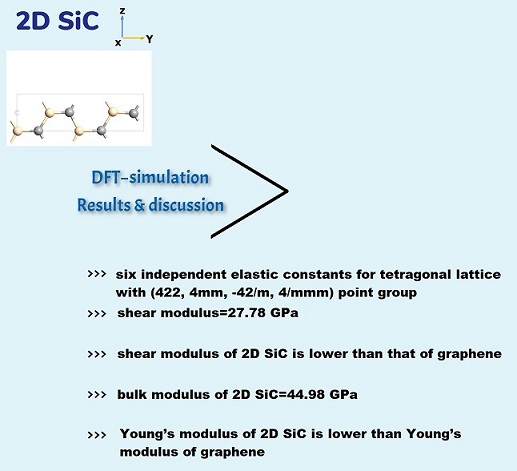
Abstract 2-Dmensional silicon carbide (2D SiC) provides several advantages compared to the bulk silicon carbide, due to its two-dimensional structure. Elastic constants and elastic moduli of 2D carbide nanotubes were calculated employing density functional theory (DFT). There are six independent elastic constants for tetragonal lattice with (422, 4mm, -42/m, 4/mmm) point group. The calculated , , , , ,  of 2D SiC are reported in this work. The results suggest that the shear modulus of 2D SiC is 27.78 GPa, which is lower than that of the of single layered graphene sheet (=0.22 TPa). The bulk modulus of 2D SiC is 44.98 GPa as well. Moreover, Young’s modulus of 2D SiC is lower than Young’s modulus of single layered graphene sheet. Compared to Young’s modulus of the amorphous phase of the SiC (=313.6 GPa), Young’s modulus of 2D SiC (=156.19 GPa) is smaller. The main reason is that the stiffness of the 2D SiC in the x direction is smaller than the stiffness of the bulk SiC.

Determination of Phenolic and Flavonoid Contents of Roots and Shoots of Euphorbia serpens Kunth Using Different Solvents

Determination of Phenolic and Flavonoid Contents of Roots and Shoots of Euphorbia serpens Kunth Using Different Solvents

Volume 2, Issue 1, June 2024, Pages 59-66

https://doi.org/10.22034/cas.2022.354096.1026

Mehdi Dehghani, Hamid Beyzaei, Zahra Ebrahimnezhad

Abstract Euphorbia serpens Kunth (Euphorbiaceae) is an exotic annual plant species native to South America but is regarded as a pantropical weed. In this paper, the total phenolic and flavonoid contents of ethanolic, methanolic, dichloromethane, and petroleum ether extracts of shoots and roots of Euphorbia serpens were assessed in vitro. The plant materials were collected from Zabol, Sistan and Baluchestan in June 2022. The Folin-Ciocalteu and aluminum chloride colorimetric instructions were followed to evaluate the total phenolic and flavonoid contents of the extracts, respectively. The methanolic extract of aerial parts contained the highest amount of phenolic compounds (59.205 mg GAE/g), while the lowest content of phenols was found in the dichloromethane extract of roots (29.794 mg GAE/g). Also, the greatest amount of flavonoids was recorded for methanol extracts of aerial parts (34 mg RE/g), whereas the ethanol extract of roots contained the lowest amount of flavonoids (1.204 mg q/g). The aerial parts of Euphorbia serpens, in general, contain higher amounts of polyphenols as compared with the underground parts. The results also showed that phenolic and flavonoid contents vary significantly with the employed solvent. It can be concluded that the aerial parts of Euphorbia serpens are rich sources of polyphenolic compounds, signaling their potential for high antioxidant activity and nutritional and pharmaceutical importance.